Table of contents
Want a quote for a 2025 EV with a clear breakdown?
The most common question we get about Tesla in Panama isn’t about range or charging — it’s simply: are there Teslas here?
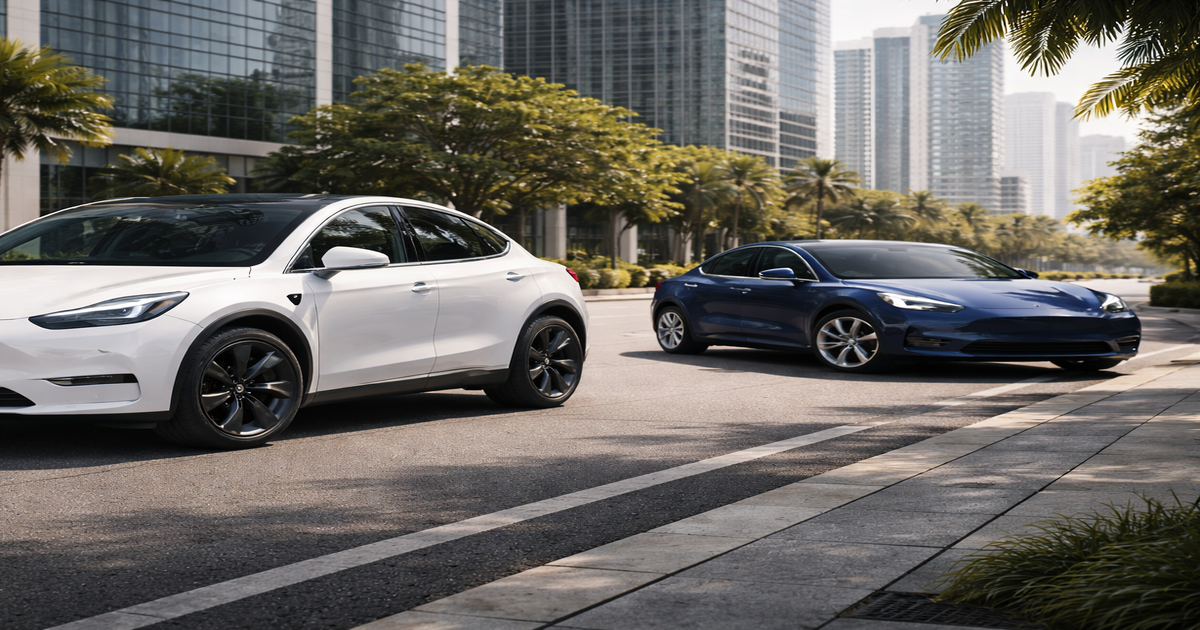
The answer in 2026 is yes, and growing. While Tesla has no official dealership in Panama, the Tesla Motors Club forums, Facebook groups, and the @tesla.pty Instagram account show an active and growing community of Panamanian owners. The Model Y and Model 3 drive through Panama City, charge on the Evergo network, and pass ATTT technical inspection. The ecosystem works.
This guide explains how, why, and what you need to know before joining.
Tesla’s presence in Panama: what exists today
Tesla operates in Panama indirectly. There is no physical dealership, no Superchargers, and no official service center in the country. What does exist:
- Private and specialized importers who bring vehicles from the US, China, or Europe with all customs documentation and ATTT homologation handled.
- Active owner community — Tesla Motors Club forum has specific threads from Panamanian owners with real experiences dating back to 2021.
- Full Evergo compatibility — Panama’s most extensive fast-charging network supports the CCS2 connector used by international-spec Teslas.
- PideTuCarro.com — specialized service for importing Tesla Model 3 and Model Y with complete process, documentation, and tracking.
The absence of an official dealership is not an obstacle in 2026 — it’s simply a market characteristic that needs to be understood.
Tesla models available in Panama
Two models circulate predominantly in the Panamanian market:
Tesla Model 3
The sedan that popularized premium EVs globally is also the most-seen Tesla in Panama. Compact, efficient, with the most refined driving dynamics in the lineup — it’s the ideal vehicle for primarily urban use with occasional interior trips.
| Version | Battery | WLTP Range | Drive | 0–100 km/h |
|---|---|---|---|---|
| Standard Range | ~60 kWh | ~513 km | RWD | 6.1s |
| Long Range | ~82 kWh | 576 km | RWD | 5.0s |
| Performance | ~82 kWh | 528 km | AWD | 3.1s |
Real range in Panama with permanent A/C: subtract approximately 10–15% from WLTP figures.
Best for: professionals, couples, urban drivers who value the driving experience over cargo space.
Tesla Model Y
The world’s best-selling SUV in 2023. Same platform as the Model 3, but 10 cm taller, more cargo space (854 liters in 5-seat configuration including frunk), and an optional third-row seat.
| Version | Battery | WLTP Range | Drive | 0–100 km/h |
|---|---|---|---|---|
| Long Range | ~82 kWh | 533 km | AWD | 5.0s |
| Performance | ~82 kWh | 514 km | AWD | 3.7s |
Best for: families, drivers coming from SUVs, those who prioritize practicality without sacrificing Tesla technology.
What about Model S, Model X, and Cybertruck?
The Model S and Model X exist in Panama in very small numbers — private imports, more expensive and logistically complex. The Cybertruck, launched in the US in 2023, could technically be imported but its dimensions (5.68 m long) and US-only specs limit its practicality for the Panamanian context.
Real range in Panama’s climate
WLTP range is a standard European measurement in moderate temperature conditions. Panama has two factors that affect it:
1. Permanent air conditioning The A/C is the largest additional energy consumer in a tropical EV. In a Model Y Long Range, constant A/C at 22°C can reduce range by 40–70 km compared to the WLTP figure, depending on ambient temperature and direct sun exposure.
2. Panama City traffic Here something positive happens: regenerative braking recovers energy in slow traffic — the opposite of what happens with a gasoline engine that simply consumes more in traffic. Tesla’s regenerative model is especially efficient in stop-and-go conditions.
Net result for Panama:
| Model | Official WLTP | Estimated real (Panama) | City vs Highway |
|---|---|---|---|
| Model 3 Long Range | 576 km | 460–510 km | City: better / Highway: worse |
| Model Y Long Range | 533 km | 420–470 km | City: better / Highway: worse |
In practical terms: the Model Y covers Panama City–Chitré roundtrip (≈440 km) without an intermediate charge under normal usage conditions.
Why Tesla works well in Panama
Minimal maintenance
Tesla has the lowest maintenance profile of any vehicle in its price range. Without an internal combustion engine, there’s no:
- Oil change
- Timing belt
- Fuel filter
- Exhaust system
- Clutch
Brakes last twice as long or more than on conventional vehicles thanks to regenerative braking — in city driving, the physical brake pedal is barely used. Real periodic expenses are: tires (every 40,000–60,000 km), brake fluid (every 2 years), and cabin HVAC filters.
OTA updates
Tesla updates its software remotely, just like your phone. Autopilot functions, energy efficiency, user interface, and even performance characteristics improve without visiting a shop. A 2023 Tesla in Panama in 2026 has completely different and more capable software than when it left the factory.
Autopilot and driver assistance
Standard Autopilot (included with all models) manages speed and following distance on the highway — especially useful on the Pan-American Highway. The optional Full Self-Driving (FSD) adds more capabilities, though its availability and behavior on Panama’s streets varies.
Thermal management in tropical climate
Tesla’s battery uses active liquid cooling — it doesn’t rely on air to cool down. The system monitors cell temperature in real time and adjusts charge and discharge power to keep the battery in optimal range. In Panamanian practice, this means the battery doesn’t degrade faster in summer than in winter.
Charging in Panama: what works and what doesn’t
This is the most important point any prospective Tesla owner must understand before importing:
There are no Superchargers in Panama. Tesla’s proprietary network has coverage in Costa Rica and Colombia, but hasn’t reached the isthmus yet.
This isn’t a problem — if you know what to charge with:
Tesla-compatible charging in Panama
| Type | Connector | Compatibility | Speed |
|---|---|---|---|
| Home 120V | Type 2 (with adapter) | Full | ~8 km/h |
| Tesla Wall Connector at home | Type 2 | Full | ~55 km/h |
| Evergo AC public | Type 2 | Full | 22–44 km/h |
| Evergo DC fast | CCS2 | Full (international spec) | 150–250 km/h |
The key is the vehicle’s origin: Teslas imported from international markets (Europe, China) come with native CCS2. Those imported from the US come with NACS (the new American connector) and need a CCS2 adapter to use Evergo — adapters are available in the market.
Practical recommendation: 95% of Tesla owners in Panama charge at home overnight with an installed Wall Connector and never need the public network in their daily routine. The Evergo network serves as backup for interior trips.
Importing a Tesla to Panama: process overview
The import process has five main steps:
- Selection and purchase — from the US, China (Model 3/Y Chinese version has better base equipment), or Europe.
- Ocean freight — typically RoRo (Roll-on Roll-off) from Miami or Chinese ports. Estimated time: 3–6 weeks from the US, 6–10 weeks from China.
- Customs (ANA) — document submission, ITBMS payment if applicable (exempt under Law 295 for BEV). The customs agent manages correct tariff classification.
- ATTT homologation — technical inspection and approval to circulate in Panama. Includes verification of lights, braking, VIN, and electrical specifications.
- Green plate (placa verde) — special EV registration that grants circulation tax exemption for 5 years.
For the complete process with documentation and tracking, our import service covers every step from vehicle selection to delivery with registration.
Tesla vs BYD: honest comparison
The most frequent question after “are there Teslas in Panama?” is “Tesla or BYD?”
| Criteria | Tesla Model Y | BYD Seal / Atto 3 |
|---|---|---|
| Software technology | Superior (mature OTA, Autopilot) | Very good, improving |
| Battery in tropical heat | Excellent (liquid cooling) | Excellent (LFP Blade more stable) |
| Own charging network in Panama | No (Supercharger) | N/A (uses Evergo same as Tesla) |
| Local service center | No official | No official |
| Entry price | Higher | Lower |
| Range | Similar (Model Y vs Seal: tie) | Similar |
| Global brand recognition | Maximum | High and growing |
| Locally available parts | Limited | Limited |
The honest conclusion: there’s no wrong answer. Tesla wins on software, platform maturity, and brand recognition. BYD wins on entry price, LFP tech for heat, and model variety. In Panama, both are imported the same way and rely on the same charging ecosystem.
Tesla myths in Panama worth debunking
“I can’t service a Tesla in Panama” False for routine maintenance. Tires, brake fluid, and periodic inspections are handled by any shop. For software issues, Tesla offers remote diagnostics. For major hardware, it requires shipping to service centers in Costa Rica or Colombia — an infrequent scenario for a modern vehicle.
“The warranty doesn’t apply in Panama” Tesla’s warranty is manufacturer-issued and applies globally, but making a claim in Panama requires coordination with the nearest service center (San José, Costa Rica). It’s an additional step to factor in when buying.
“The heat destroys the battery” Tesla uses active liquid cooling. The battery doesn’t “cook” — the system actively maintains it at optimal temperature. Degradation in tropical climates is comparable to temperate climates.
“There are no chargers in Panama” The Evergo network has over 40 points nationwide. For daily use, charging is at home. For interior trips, there are strategic points along the route.
Conclusion
Tesla works in Panama — not despite the lack of official infrastructure, but because the conditions of the Panamanian market fit the vehicle’s profile well: drivers who charge at home, who value technology and low maintenance, and who benefit from the 0% duty under Law 295.
The question isn’t whether Tesla works here. The question is which model suits you and how to import it correctly. At PideTuCarro, we specialize in answering both.
Start here
Ready to get your EV quote?
Clear quote, real breakdown. No surprises.
*May vary by model/specification and regulatory changes.
Related posts
BYD in Panama 2026: Complete Guide to All Available Models
Complete guide to BYD cars available in Panama in 2026: BYD Dolphin, Atto 3, Seal, Han, Tang and Shark. Range comparison, estimated prices, and which model fits your lifestyle.
Plug-in Hybrid vs Full Electric in Panama: Which One Should You Get in 2026?
PHEV or BEV in Panama? Honest comparison between plug-in hybrids and full electric cars in 2026: real costs, maintenance, tax incentives, and why for most Panamanians the electric wins.
Sources
- 1. Tesla Motors Club — Tesla ownership in Panama? (forum). https://teslamotorsclub.com/tmc/threads/tesla-ownership-in-panama.327789/
- 2. Tesla Motors Club — Tesla in Panama (forum). https://teslamotorsclub.com/tmc/threads/tesla-in-panama.227262/
- 3. Reddit r/Panama — What electric cars are currently being driven in Panama? Mar 2026. https://www.reddit.com/r/Panama/comments/1jxv0q8/
- 4. Official Gazette — Law 295 of April 25, 2022, promoting electric mobility in land transport. https://www.gacetaoficial.gob.pa/pdfTemp/29523_A/91344.pdf
- 5. Evergo Panama — EV charging network. Accessed Mar 30, 2026. https://evergo.com.pa/
- 6. Tesla — Model 3 and Model Y specifications. Accessed Mar 30, 2026. https://www.tesla.com/model3 / https://www.tesla.com/modely
- 7. ATTT — Land Transit and Transport Authority, vehicle homologation. https://www.attt.gob.pa/
- 8. IEA — Global EV Outlook 2024. https://www.iea.org/reports/global-ev-outlook-2024