Table of contents
Want a quote for a 2025 EV with a clear breakdown?
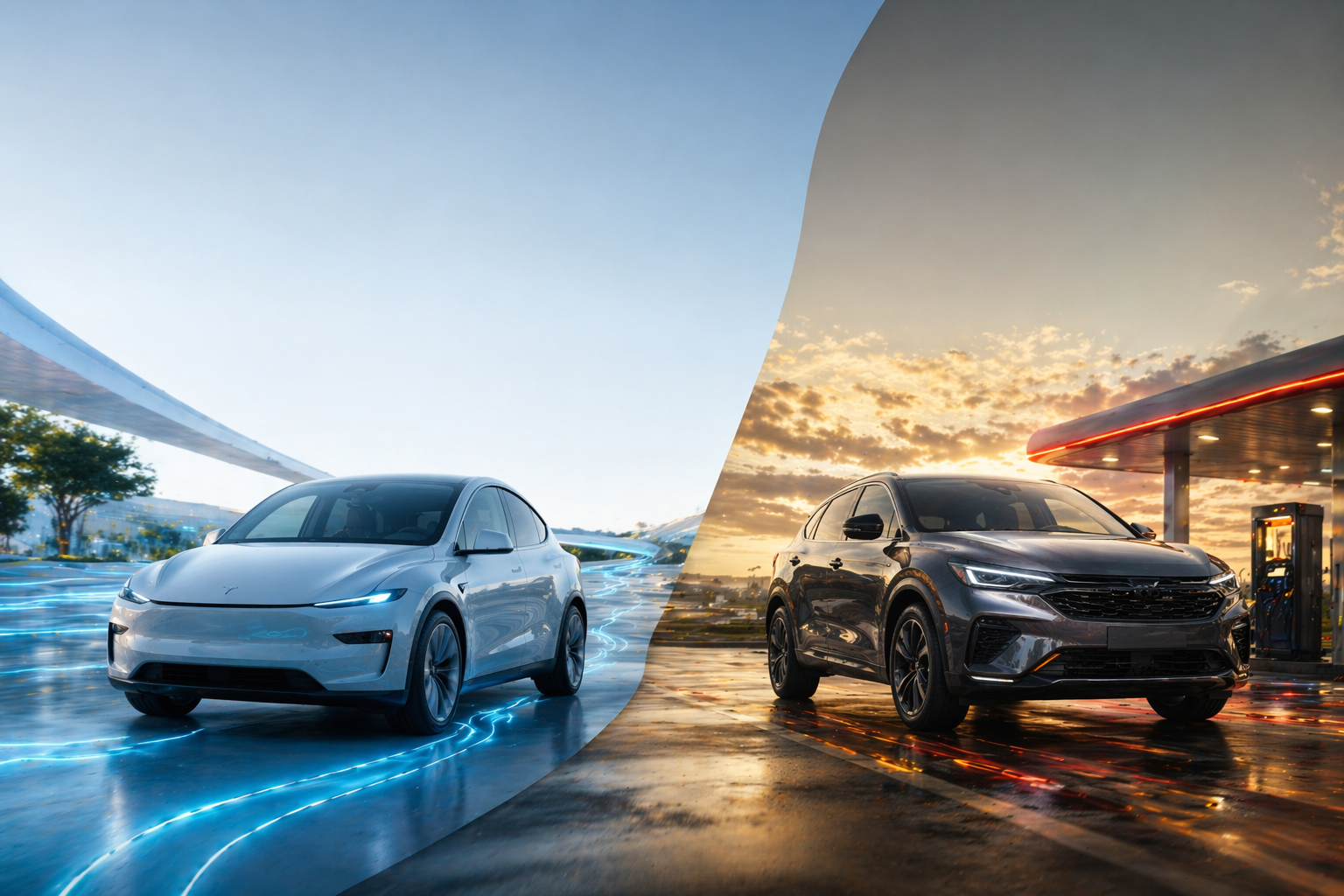
In Panama in 2026, gas prices are at historic highs and the conversation about electric vehicles is no longer niche — it’s happening at the family dinner table. But when the moment to decide arrives, many drivers get stuck between two options: the plug-in hybrid (PHEV), which promises the best of both worlds, and the pure electric (BEV), which promises to cut gasoline completely.
This guide makes the honest comparison. And we’ll give the verdict upfront: for most Panamanians in 2026, the pure electric wins. But there are real exceptions, and it’s worth understanding them.
First: what exactly is each one?
Before comparing, the terms need to be clarified — they’re frequently mixed up in Panama:
| Type | Propulsion | Plugs in? | Needs gas? | Law 295 tariff |
|---|---|---|---|---|
| HEV (traditional hybrid) | Gas + small electric | No | Yes, always | Partial |
| PHEV (plug-in hybrid) | Gas + electric ~50–70 km | Yes | Yes, when battery depleted | Partial |
| BEV (pure electric) | 100% electric | Yes | No | 0% complete |
| MHEV (mild hybrid) | Gas with minor electric assist | No | Yes, always | N/A |
This guide compares PHEV vs BEV — the two that plug in and the only ones worth analyzing in the context of real savings.
PHEVs available in Panama today
Panama’s PHEV market is growing but still limited. Available models in 2026:
- Chevrolet Captiva PHEV 2026 — most accessible, compact SUV, ~50 km electric
- Lynk & Co 01 PHEV — premium Chinese SUV, ~80 km electric
- Volvo XC90 plug-in hybrid — luxury segment, ~45 km electric
- BYD Shark — PHEV pickup, ~100 km electric, 4,500 kg towing capacity
- Changan — several models presented at the 2025 Panama Motor Show
Typical PHEV electric range: 50–80 km. Enough for most days in Panama City. The problem comes after that.
The PHEV trap: the driver who never plugged in
Here’s the catch nobody mentions at the dealership:
A European real-world behavior study (Transport & Environment, 2020) found that PHEV drivers in Europe drove in electric mode for only 45% of their kilometers — less than half the theoretical potential. In markets with less charging culture and less infrastructure, that percentage drops further.
What happens if you don’t charge regularly?
A PHEV with a depleted battery running only on gasoline carries 200–400 kg more than an equivalent conventional vehicle — dragging the battery, electric motors, and additional electronics without using them. The result: it consumes more gasoline than a conventional car of the same size and costs more in maintenance.
The PHEV is a powerful tool in the hands of the disciplined driver who charges every day. For the average driver who “sometimes forgets” or doesn’t have a home charger, it can be the worst of all options.
Real comparison: PHEV vs BEV in Panama 2026
Monthly energy cost
Base profile: urban commuter in Panama City, 1,500 km/month.
| Item | PHEV (daily charging) | PHEV (no charging) | BEV |
|---|---|---|---|
| Electric km | ~900 km (60%) | ~0 km | 1,500 km |
| Electricity cost | B/.16/mo | B/.0 | B/.27/mo |
| Gasoline cost | B/.42/mo | B/.170/mo | B/.0 |
| Total energy/month | ~B/.58 | ~B/.170 | ~B/.27 |
The BEV costs B/.27/month in energy — less than half the well-used PHEV, and a fraction of the poorly-used PHEV.
Annual maintenance
| Component | PHEV | BEV |
|---|---|---|
| Oil change | Yes (gas engine) | No |
| Timing belt/chain | Yes | No |
| Exhaust system | Yes | No |
| Brakes | Moderate | Low (regenerative) |
| Traction battery | 1 smaller system | 1 main system |
| Annual estimate | B/.600–1,200 | B/.200–400 |
The BEV completely eliminates combustion engine maintenance. The PHEV maintains both systems — and when something fails in the management system between the engine and electric motors, diagnostic and repair costs are significantly higher than in a conventional vehicle.
Tax incentives under Law 295
| Benefit | PHEV | BEV |
|---|---|---|
| Import duty | Partial (by classification) | 0% |
| ITBMS exemption | Partial | Yes |
| Circulation tax exemption | Partial | 5 full years |
| Green plate (placa verde) | Depends | Yes |
This point is critical: Law 295 was designed for pure BEVs. PHEVs may qualify for some partial benefits depending on their tariff classification, but don’t receive the full package. On a B/.30,000–40,000 import, the duty difference can be B/.2,000–5,000.
Total 5-year cost (estimated)
| Item | PHEV | BEV |
|---|---|---|
| Base purchase price | Similar | Similar |
| Law 295 duty savings | Partial | Greater |
| Energy (60 months) | B/.3,480 | B/.1,620 |
| Maintenance (60 months) | B/.4,500 | B/.1,500 |
| Accumulated difference | — | B/.4,860–8,000 in BEV’s favor |
Over five years, the urban Panamanian driver in a BEV saves between B/.4,860 and B/.8,000 compared to the equivalent PHEV — not counting import duty differences.
When a PHEV actually makes sense in Panama
To be fair: there are profiles for which a PHEV is the right decision today.
✓ You live or frequently work in the country’s interior If your routine includes regular trips to Chiriquí, Darién, Veraguas, or rural areas where charging infrastructure is scarce or nonexistent, the PHEV’s gasoline engine is real insurance. The Evergo network is growing, but in 2026 it remains primarily urban.
✓ You need towing capacity or work payload The BYD Shark PHEV with 4,500 kg towing capacity and 6 kW V2L has no BEV equivalent in the Panamanian market today. If you work in construction, agriculture, or logistics, the Shark fills a real gap.
✓ You can’t install a charger If you live in a building without charging infrastructure and can’t install a dedicated outlet, BEV logistics get complicated. A PHEV charges more slowly but can use any 120V outlet with enough time.
✓ Genuine range anxiety, not psychological For drivers who genuinely cover more than 400 km in a single day regularly — commercial drivers, salespeople with long routes — the backup engine has real practical value.
Why the BEV wins for most people
Panama has a driving profile that radically favors the pure electric:
1. Trips are short The average daily drive for a Panama City commuter is between 30 and 60 km — a fraction of any modern BEV’s range. Even the BYD Dolphin with 340 km covers an entire week without charging.
2. You charge at home overnight 95% of BEV owners in Panama charge at home with a Wall Connector or 240V outlet. They don’t depend on the public network for their daily routine. The “lack of chargers” is a myth for the urban driver who sleeps at home every night.
3. Gas prices aren’t going down The three simultaneous geopolitical crises that pushed prices in 2024–2026 — Middle East conflict, OPEC+ cuts, and Red Sea tensions — have no short-term resolution. Every month that passes, the BEV’s accumulated savings grow.
4. Maintenance is radically lower No combustion engine, no oil, no timing belt, no exhaust. The BEV eliminates entire categories of expenses that most surprise Panamanian drivers in the first three years of ownership.
5. Legal incentives were designed for BEV Law 295 was written with 100% electric vehicles in mind. Maximizing it means choosing BEV.
The verdict by your profile
| Your situation | Recommendation |
|---|---|
| Drive mainly in Panama City | BEV |
| Have or can install a home charger | BEV |
| Make occasional interior trips (1–2x/month) | BEV — Evergo fast charge en route |
| Frequently travel interior without chargers | PHEV |
| Need towing or have a rural farm/business | PHEV (BYD Shark) |
| Can’t install charger in your building | PHEV as a transition |
| Want lowest total cost over 5 years | BEV |
| It’s your first EV and you feel uncertain | BEV — the fear disappears within a week |
Myth: “The PHEV is safer because I’ll never run out of energy”
This argument has emotional logic but fails in Panamanian practice. With a modern BEV (420–570 km range) charged at home every night:
- In Panama City you never run out of charge in your normal routine.
- For interior trips, Evergo chargers exist in La Chorrera, Santiago, David, and intermediate points — enough for the Pan-American highway route.
- The network grows every year.
Fear of “zero range” is the most powerful argument PHEV salespeople use — and the least relevant for the average Panamanian driver who sleeps at home every night.
Conclusion
The plug-in hybrid is a transitional technology — useful for those who genuinely can’t depend on electric infrastructure yet. But for the urban Panamanian commuter of 2026, with a home charger, with the Evergo network growing, and with Law 295 incentives at maximum, the pure electric is the financially superior, mechanically simpler, and environmentally more coherent decision.
The PHEV says “maybe electric.” The BEV says “electric, now.”
If you’re ready to make the move, at PideTuCarro we import the BEV that best fits your profile — with the entire process handled.
Start here
Ready to get your EV quote?
Clear quote, real breakdown. No surprises.
*May vary by model/specification and regulatory changes.
Related posts
BYD in Panama 2026: Complete Guide to All Available Models
Complete guide to BYD cars available in Panama in 2026: BYD Dolphin, Atto 3, Seal, Han, Tang and Shark. Range comparison, estimated prices, and which model fits your lifestyle.
Tesla in Panama 2026: Available Models, Range & Why It Works Here
Are there Teslas in Panama? Yes — and growing. Complete guide to Tesla Model 3 and Model Y in Panama: real range, charging options, why they work in tropical conditions, and how to import one in 2026.
Sources
- 1. Official Gazette — Law 295 of April 25, 2022, promoting electric mobility in land transport. https://www.gacetaoficial.gob.pa/pdfTemp/29523_A/91344.pdf
- 2. Panama Open Data — Electric and hybrid vehicles registered in Panama. https://www.datosabiertos.gob.pa/dataset/3f52b8c9-2574-4466-a1b9-5b61de400153
- 3. Mobility Portal — Panama opts for hybrid vehicles: market share 2024. https://www.mobilityportal.eu/market-share-hibridos-panama
- 4. Chevrolet Panama — Captiva PHEV 2026. https://www.chevrolet.com.pa/captiva-hibrido
- 5. Lynk & Co Panama — Lynk & Co 01 PHEV. https://www.lynkco.com.pa/modelos/lynkco-01-phev
- 6. ASEP — Electricity rates for regulated customers. Valid Jul–Dec 2025. https://asep.gob.pa/wp-content/uploads/electricidad/tarifas/
- 7. National Energy Secretariat / siePANAMÁ — Internal reference prices, 95 gasoline. https://siepanama.energia.gob.pa/
- 8. Evergo Panama — EV charging network. Accessed Mar 30, 2026. https://evergo.com.pa/
- 9. Transport & Environment — Real-world PHEV usage study, 2020. https://www.transportenvironment.org/